

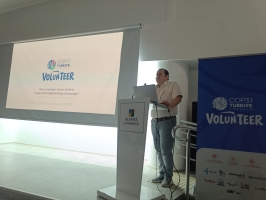

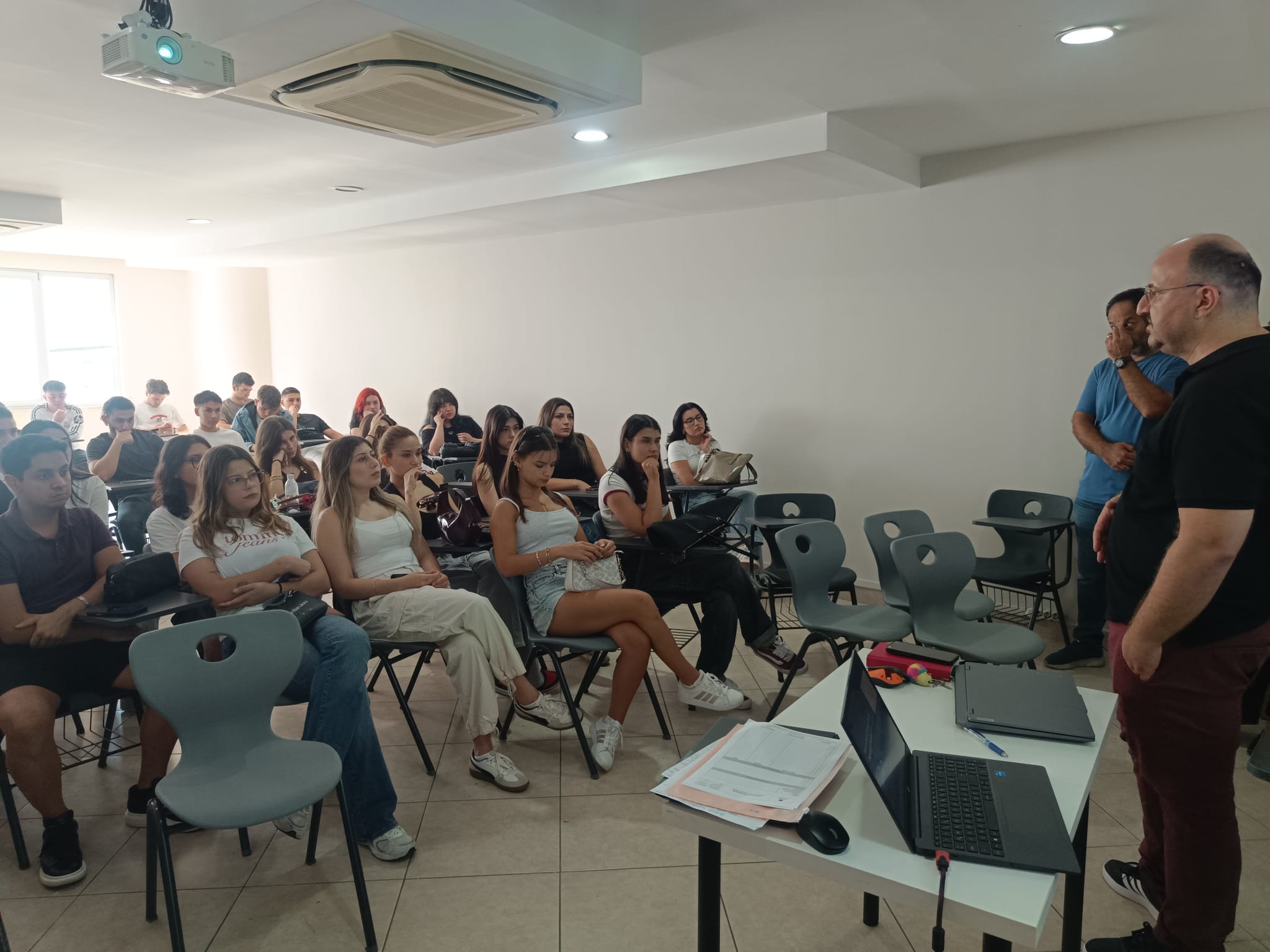
As part of the COP31 initiatives, the mobile event unit of the Ministry of Environment, Urbanization and Climate Change met with students at our campus. During the seminar sessions, Assoc. Prof. Dr. S...
Curriculum and Course Contents
DEPARTMENT OF MANAGEMENT INFORMATION SYSTEMS
Faculty of Economics, Administrative and Social Sciences
You can access detailed Course Information Packages (Bologna) Here.
Last Updated: October 9, 2026
| YEAR 1 | |||||
|---|---|---|---|---|---|
| SEMESTER 1 (FALL) | |||||
| Course Code | Course Name | T | P | C | ECTS |
| CSE 103 | Computer Programming I | 3 | 2 | 4 | 5 |
| MAT 105 | Calculus I | 3 | 0 | 3 | 5 |
| MIS 105 | Management Information Systems | 3 | 0 | 3 | 6 |
| MIS 107 | Introduction to Business Management | 3 | 0 | 3 | 5 |
| SEC 101 | Elective Course 1 (University Elective) | 3 | 0 | 3 | 5 |
| ENG 111 | Academic English I | 2 | 0 | 2 | 2 |
| TKL 111 | Turkish Language I | 2 | 0 | 2 | 2 |
| YTO 111 | Turkish Language for Foreign Students I (In place of TKL 111) | 2 | 0 | 2 | 2 |
| SEMESTER TOTAL | 20 | 30 | |||
| SEMESTER 2 (SPRING) | |||||
| Course Code | Course Name | T | P | C | ECTS |
| CSE 104 | Computer Programming II | 3 | 2 | 4 | 5 |
| MIS 104 | General Economy | 3 | 0 | 3 | 5 |
| MIS 106 | Statistics | 3 | 0 | 3 | 5 |
| MIS 108 | Computer Hardware | 3 | 0 | 3 | 6 |
| SEC 102 | Elective Course 2 (University Elective) | 3 | 0 | 3 | 5 |
| TKL 112 | Turkish Language II | 2 | 0 | 2 | 2 |
| YTO 112 | Turkish Language for Foreign Students II (In place of TKL 112) | 2 | 0 | 2 | 2 |
| ENG 112 | Academic English II | 2 | 0 | 2 | 2 |
| SEMESTER TOTAL | 20 | 30 | |||
| YEAR 2 | |||||
|---|---|---|---|---|---|
| SEMESTER 3 (FALL) | |||||
| Course Code | Course Name | T | P | C | ECTS |
| MIS 201 | Database Management | 3 | 2 | 4 | 6 |
| MIS 203 | System Analysis | 3 | 0 | 3 | 6 |
| MIS 205 | Introduction to Data Science | 2 | 0 | 3 | 6 |
| MIS 207 | Strategic Management | 3 | 0 | 3 | 5 |
| SEC 201 | Elective Course 3 (University Elective) | 3 | 0 | 3 | 5 |
| HIST 211 | Principles of Atatürk and the History of Turkish Revolution I | 2 | 0 | 2 | 2 |
| YTT 211 | Principles of Atatürk and the History of Turkish Revolution for Foreign Students I (In place of HIST 211) | 2 | 0 | 2 | 2 |
| SEMESTER TOTAL | 18 | 30 | |||
| SEMESTER 4 (SPRING) | |||||
| Course Code | Course Name | T | P | C | ECTS |
| MIS 200 | Summer Practice I | 0 | 0 | 0 | 3 |
| MIS 202 | Operations Research | 3 | 0 | 3 | 5 |
| MIS 204 | Financial Accounting | 3 | 0 | 3 | 5 |
| MIS 206 | Decision Support Systems | 3 | 0 | 3 | 5 |
| MIS 208 | Business Intelligence Systems | 3 | 0 | 3 | 5 |
| SEC 202 | Elective Course 4 (University Elective) | 3 | 0 | 3 | 5 |
| HIST 212 | Principles of Atatürk and the History of Turkish Revolution II | 2 | 0 | 2 | 2 |
| YTT 212 | Principles of Atatürk and the History of Turkish Revolution for Foreign Students II (In place of HIST 212) | 2 | 0 | 2 | 2 |
| SEMESTER TOTAL | 17 | 30 | |||
| YEAR 3 | |||||
|---|---|---|---|---|---|
| SEMESTER 5 (FALL) | |||||
| Course Code | Course Name | T | P | C | ECTS |
| MIS 301 | Research Methods | 3 | 0 | 3 | 5 |
| MIS 303 | Optimization Techniques | 2 | 2 | 3 | 5 |
| MIS 305 | Strategic Management and Planning | 3 | 0 | 3 | 5 |
| MIS 307 | Introduction to Artificial Intelligence | 2 | 2 | 3 | 5 |
| SEC 301 | Elective Course 5 (Departmental Elective) | 3 | 0 | 3 | 5 |
| SEC 303 | Elective Course 6 (Departmental Elective) | 3 | 0 | 3 | 5 |
| SEMESTER TOTAL | 18 | 30 | |||
| SEMESTER 6 (SPRING) | |||||
| Course Code | Course Name | T | P | C | ECTS |
| MIS 300 | Summer Practice II | 0 | 0 | 0 | 3 |
| MIS 302 | Enterprise Resource Planning | 2 | 2 | 3 | 6 |
| MIS 304 | Project Management | 3 | 0 | 3 | 6 |
| MIS 306 | Computer Networks | 2 | 2 | 3 | 5 |
| SEC 302 | Elective Course 7 (Departmental Elective) | 3 | 0 | 3 | 5 |
| SEC 304 | Elective Course 8 (Departmental Elective) | 3 | 0 | 3 | 5 |
| SEMESTER TOTAL | 15 | 30 | |||
| YEAR 4 | |||||
|---|---|---|---|---|---|
| SEMESTER 7 (FALL) | |||||
| Course Code | Course Name | T | P | C | ECTS |
| MIS 401 | Management Information Systems Seminar | 3 | 0 | 3 | 7 |
| MIS 403 | System Thinking | 2 | 0 | 2 | 3 |
| MIS 405 | Technology and Innovation Management | 3 | 0 | 3 | 5 |
| SEC 401 | Elective Course 9 (Departmental Elective) | 3 | 0 | 3 | 5 |
| SEC 403 | Elective Course 10 (Departmental Elective) | 3 | 0 | 3 | 5 |
| SEC 405 | Elective Course 11 (Departmental Elective) | 3 | 0 | 3 | 5 |
| SEMESTER TOTAL | 17 | 30 | |||
| SEMESTER 8 (SPRING) | |||||
| Course Code | Course Name | T | P | C | ECTS |
| MIS 400 | Graduation Project | 0 | 4 | 4 | 10 |
| MIS 402 | Ethics in Management Information Systems | 3 | 0 | 3 | 5 |
| SEC 402 | Elective Course 12 (Departmental Elective) | 3 | 0 | 3 | 5 |
| SEC 404 | Elective Course 13 (Departmental Elective) | 3 | 0 | 3 | 5 |
| SEC 406 | Elective Course 14 (Departmental Elective) | 3 | 0 | 3 | 5 |
| SEMESTER TOTAL | 16 | 30 | |||
COURSE ABBREVIATIONS & NOTES
T: Theoretical Hours P: Practical Hours C: Local Credit ECTS: European Credit Transfer and Accumulation System
Note: University elective courses (SEC 101, SEC 102, SEC 201, SEC 202) are selected from the shared university elective course pool.
Compulsory Courses
YEAR 1
SEMESTER 1 (FALL)
CSE 103 Computer Programming I
T: 3 | P: 2 | C: 4 | ECTS: 5
Course Content:
The aim of this course is to define and understand problems, develop problem-solving skills, grasp algorithmic and programming logic, become familiar with fundamental algorithms, and acquire core programming proficiency in a programming language. Topics include algorithm and programming principles; problem-solving stages; flowcharts; pseudocode; searching and sorting algorithms; variables, constants, and basic data types; program control flow structures (decision and loop structures); and one-dimensional arrays.
Learning Outcomes:
- Understands the concept of algorithms and fundamental programming elements.
- Represents algorithms using flowcharts and pseudocode.
- Develops computer programs to solve structured problems.
MAT 105 Calculus I
T: 3 | P: 0 | C: 3 | ECTS: 5
Course Content:
The objective of this course is to equip students with foundational mathematical knowledge and analytical competencies required in their professional field. Topics include numbers, sets, equations, and inequalities; functions; exponential and logarithmic functions; trigonometric and inverse trigonometric functions; limits and continuity for single-variable functions; definition and rules of differentiation; applications of derivatives, function analysis, and curve sketching; limits using differentiation; and integral calculus.
Learning Outcomes:
- Explains fundamental concepts related to numbers, sets, and functions.
- Performs mathematical operations involving exponential, logarithmic, and trigonometric functions.
- Interprets limits and continuity, calculating limit values accurately.
- Applies differentiation rules and uses derivatives in optimization and marginal analysis business problems.
- Calculates definite and indefinite integrals for applied problem scenarios.
MIS 105 Management Information Systems
T: 3 | P: 0 | C: 3 | ECTS: 6
Course Content:
This course aims to teach the strategic significance of information systems and technology in the contemporary corporate arena, examining why and how organizations deploy IT solutions and how business objectives shape IT infrastructure. Topics include business information systems principles: resource management, customer relationship management, supply chain management, legal and professional issues; strategic impacts of IS; and project management: selection, scheduling, control, and performance evaluation.
Learning Outcomes:
- Defines core concepts of management information systems (data, information, system, technology) and explains their business value.
- Analyzes information systems utilized in essential business functions such as marketing, operations, accounting, finance, and human resources.
- Explains integrated enterprise architectures (ERP, CRM, SCM) and the competitive advantages they provide.
- Articulates the role of data management, relational databases, and data warehousing in corporate strategy.
- Demonstrates how business intelligence and decision support systems empower managerial decision-making.
- Identifies primary cybersecurity vulnerabilities and key security measures within corporate systems.
- Interprets the managerial implications of big data, artificial intelligence, data mining, and Industry 4.0.
- Assesses organizational information requirements for a given scenario and proposes an appropriate system solution.
MIS 107 Introduction to Business Management
T: 3 | P: 0 | C: 3 | ECTS: 5
Course Content:
This course provides a holistic overview of business administration by introducing core business concepts, corporate environments, operational functions, and fundamental managerial frameworks. Topics include basic economic and business terminology, organizational legal structures and enterprise formation, business ethics and corporate social responsibility, international business dynamics, management, organizing, human resources and employment relations, and production management.
Learning Outcomes:
- Defines foundational business administration and economic concepts.
- Explains legal and organizational structures of enterprises.
- Identifies fundamental dimensions of international business operations.
- Explains human resource workflows, employee-employer dynamics, and workplace relations.
- Analyzes contemporary management and organizational structures.
ENG 111 Academic English I
T: 2 | P: 0 | C: 2 | ECTS: 2
Course Content:
This course aims to develop students' reading, listening, speaking, and writing competencies alongside grammatical accuracy and vocabulary needed for academic and professional tracks. Designed at the CEFR A1 proficiency level, it provides core foundations in grammatical structures, daily communication routines, and listening comprehension.
Learning Outcomes:
- Understands straightforward daily instructions and conversational cues.
- Extracts meaning from simple informational passages supported by charts and illustrations.
- Scans brief texts to locate factual details (who, what, where, when).
- Participates in simple verbal exchanges on familiar everyday subjects.
- Completes standard personal and informational registration forms.
- Produces basic descriptive sentences about familiar environments, studies, and residences.
- Recognizes familiar spoken phrases and expressions in straightforward audio passages.
TKL 111 Turkish Language I
T: 2 | P: 0 | C: 2 | ECTS: 2
Course Content:
This course aims to familiarize students with the structure, historical development, and rules of the Turkish language, fostering effective written and oral communication capabilities. Topics encompass the characteristics of language, language-culture relationships, the classification and historical evolution of Turkish among world languages, phonetics, morphology, spelling and punctuation rules, and principles of academic composition.
Learning Outcomes:
- Explains the cultural and social significance of language.
- Describes the historical evolution of Turkish and its position among world languages.
- Identifies phonetic and morphological characteristics of Turkish.
- Applies spelling and punctuation rules accurately in composition.
- Composes structured, coherent, and concise written texts.
SEMESTER 2 (SPRING)
CSE 104 Computer Programming II
T: 3 | P: 2 | C: 4 | ECTS: 5
Course Content:
This course delivers mastery over the object-oriented programming (OOP) paradigm using the Python language, enabling students to construct scalable modular software applications. Topics cover object-oriented design; class and object architectures; methods, attributes, and constructors; core OOP pillars: encapsulation, abstraction, inheritance, and polymorphism; data structures; user interface fundamentals; and database connectivity workflows.
Learning Outcomes:
- Defines and articulates foundational concepts of object-oriented programming.
- Develops functional software applications utilizing modular class structures.
- Integrates appropriate standard libraries and packages during application development.
MIS 104 General Economy
T: 3 | P: 0 | C: 3 | ECTS: 5
Course Content:
This course provides insight into major economic issues facing markets, illustrating how economic modeling identifies growth constraints and guides policy solutions. Topics include economic principles: scarcity, choice, utility, production, supply and demand dynamics, elasticity, consumer and firm behavior, market structures, income distribution, national income accounting, inflation, unemployment, and monetary systems.
Learning Outcomes:
- Defines and analyzes fundamental economic principles.
- Explains market allocation mechanisms addressing what, how, and for whom to produce.
- Evaluates market equilibrium conditions across diverse competitive environments.
- Distinguishes between microeconomic behaviors and macroeconomic aggregates.
- Analyzes macroeconomic indicators and structural economic challenges.
MIS 106 Statistics
T: 3 | P: 0 | C: 3 | ECTS: 5
Course Content:
This course teaches essential statistical methodologies, data measurement scales, and probability frameworks utilized across analytical business contexts. Topics cover data collection, statistical series and visual distributions, measures of central tendency, dispersion metrics, probability axioms, and discrete/continuous probability distributions.
Learning Outcomes:
- Collects, organizes, and tabulates empirical datasets.
- Calculates and interprets measures of central tendency and dispersion.
- Performs probability computations and applies standard distribution models.
MIS 108 Computer Hardware
T: 3 | P: 0 | C: 3 | ECTS: 6
Course Content:
This course provides a comprehensive understanding of physical computer hardware architectures and operating system subsystems, examining how components interact and are administered. Topics cover microprocessors, memory architectures, storage hierarchies, I/O devices, operating system kernels, process and memory scheduling, file management, resource sharing, virtualization, system diagnostics, and security configurations.
Learning Outcomes:
- Explains the architectural design of CPUs, memory (RAM/ROM), storage devices, and motherboards.
- Assembles physical system components and configures BIOS/UEFI environments.
- Defines fundamental operating system tasks (process handling, memory management, file systems).
- Installs and configures multi-platform operating systems (Windows, Linux), managing storage partitioning and shell commands.
- Understands the layered interactions between hardware, device drivers, kernel, and user applications.
- Diagnoses hardware resource conflicts and operating system faults.
- Establishes secure working environments focusing on user permissions and data integrity.
TKL 112 Turkish Language II
T: 2 | P: 0 | C: 2 | ECTS: 2
Course Content:
This course enhances syntax comprehension, rhetorical structures, and formal writing skills in Turkish for academic and professional communication. Topics cover sentence syntax, structural ambiguities and errors, professional correspondence (petitions, CVs, formal reports, academic articles), research citations, and effective public speaking.
Learning Outcomes:
- Identifies syntactic sentence structures and grammatical constituents.
- Detects and resolves expression errors and ambiguities.
- Drafts formal professional documents conforming to standardized conventions.
- Adheres to academic integrity and scholarly citation standards.
- Delivers organized and persuasive oral presentations.
ENG 112 Academic English II
T: 2 | P: 0 | C: 2 | ECTS: 2
Course Content:
Building on foundational language skills, this course progresses towards the CEFR A1+/A2 proficiency band, strengthening receptive and productive language skills for routine academic and social interactions. Topics include past and future tenses, comparative and superlative forms, countable/uncountable nouns, modal verbs, and context-specific functional dialogues.
Learning Outcomes:
- Describes past experiences and chronological events in clear sentences.
- Communicates future arrangements, targets, and conditional plans.
- Compares individuals, services, and technical products accurately.
- Conducts transactional and collaborative conversations in standard situations.
- Reads, comprehends, and constructs organized short texts.
YEAR 2
SEMESTER 3 (FALL)
MIS 201 Database Management
T: 3 | P: 2 | C: 4 | ECTS: 6
Course Content:
This course teaches database management principles, data modeling, normalization theory, and practical administration of relational database management systems (RDBMS). Topics include conceptual data modeling, entity-relationship diagrams, normalization stages (1NF to BCNF), relational algebra, Structured Query Language (SQL), multi-table joins, nested subqueries, views, indexing strategies, and transaction performance optimization.
Learning Outcomes:
- Articulates foundational database concepts and relational data architectures.
- Applies normalization rules to eliminate redundancy and build robust schemas.
- Designs relational databases establishing primary and foreign key constraints.
- Formulates formal data retrieval queries using relational algebra.
- Executes SQL data definition (DDL) and data manipulation (DML) statements.
- Develops optimized queries with sorting, multi-table joins, and aggregate functions.
- Constructs nested subqueries, views, and stored procedures for complex reporting.
- Evaluates index structures to optimize database query execution performance.
MIS 203 System Analysis
T: 3 | P: 0 | C: 3 | ECTS: 6
Course Content:
This course focuses on the analytical phase of software development, teaching methodologies to elicit stakeholder requirements, evaluate legacy systems, and model architectural requirements. Topics include the Systems Development Life Cycle (SDLC), waterfall and agile methodologies, feasibility assessment, requirements elicitation techniques, data flow diagrams (DFD), entity-relationship modeling, object-oriented UML modeling, and systems specifications.
Learning Outcomes:
- Explains SDLC phases and evaluates traditional versus agile development methodologies.
- Conducts economic, operational, and technical feasibility studies for proposed systems.
- Gathers and classifies functional and non-functional user requirements.
- Constructs process and data models utilizing DFDs, ERDs, and UML diagrams.
- Compiles and presents comprehensive software requirements specification (SRS) reports.
MIS 205 Introduction to Data Science
T: 2 | P: 0 | C: 3 | ECTS: 6
Course Content:
This course introduces foundational data science methodologies, exploratory data workflows, statistical learning models, and analytical visualization techniques. Topics cover data types, data cleansing and missing value imputation, noise filtering, dimensionality reduction, feature selection, discretization, supervised vs. unsupervised paradigms, regression modeling, performance metrics, association rules, and visual reporting.
Learning Outcomes:
- Explains fundamental principles and pipelines of data science.
- Implements data preprocessing, outlier detection, and data transformation techniques.
- Identifies appropriate machine learning paradigms for varying business problem structures.
- Evaluates model accuracy using statistical metrics and cross-validation techniques.
MIS 207 Strategic Management
T: 3 | P: 0 | C: 3 | ECTS: 5
Course Content:
This course introduces strategic frameworks utilized by business executives, consultants, and analysts to build sustainable competitive advantages. Topics cover corporate strategic planning, macro-environmental analysis (PESTEL), industry competition models (Porter's Five Forces), internal resource audits, SWOT analysis, generic business strategies, corporate portfolios, strategy execution, operational roadmapping, and strategic control.
Learning Outcomes:
- Explains strategic management concepts and execution phases.
- Conducts external and internal environmental scans utilizing diagnostic frameworks.
- Compares corporate, business-unit, and functional strategies.
- Identifies control mechanisms and KPIs for monitoring strategic plans.
- Analyzes real-world corporate case studies to formulate strategic recommendations.
HIST 211 Principles of Atatürk and the History of Turkish Revolution I
T: 2 | P: 0 | C: 2 | ECTS: 2
Course Content:
This course examines the socio-political conditions under which the Republic of Türkiye was established, instilling modern values along with Atatürk's ideological tenets. Topics include the disintegration of the Ottoman Empire, the National Struggle, military campaigns, diplomatic treaties, and ideological dynamics underlying the establishment of the modern state.
Learning Outcomes:
- Evaluates the collapse of the Ottoman Empire and the emergence of the Turkish Republic in historical context.
- Analyzes the causes, major milestones, and strategic achievements of the War of Independence.
- Understands Atatürk's reform principles as cornerstones of modern secular governance.
SEMESTER 4 (SPRING)
MIS 200 Summer Practice I
T: 0 | P: 0 | C: 0 | ECTS: 3
Course Content:
This course allows students to observe theoretical concepts acquired during the first two years within operational institutional settings, examining IT workflows and business systems on-site. In compliance with departmental regulations, students complete practical training in public or private enterprises, logging daily assignments into an official training record and submitting an evaluative report upon completion.
Learning Outcomes:
- Analyzes organizational hierarchies and operational business processes within enterprises.
- Identifies deployed information systems and institutional technical infrastructure.
- Demonstrates teamwork, workplace adaptability, and professional accountability.
- Compiles an analytical internship report documenting technical contributions.
MIS 202 Operations Research
T: 3 | P: 0 | C: 3 | ECTS: 5
Course Content:
This course teaches quantitative formulation and mathematical optimization techniques for managerial problem-solving. Topics cover mathematical modeling, linear programming, graphical solutions, simplex algorithms, duality and sensitivity analysis, transportation and assignment problems, integer programming, network models, decision analysis, and spreadsheet optimization tools (e.g., Excel Solver).
Learning Outcomes:
- Formulates managerial decision dilemmas as formal mathematical programming models.
- Solves linear programming models using graphical and simplex procedures.
- Interprets post-optimality sensitivity reports to inform managerial decisions.
- Resolves distribution, transportation, and assignment network models.
- Implements optimization algorithms using modern software solvers.
MIS 204 Financial Accounting
T: 3 | P: 0 | C: 3 | ECTS: 5
Course Content:
This course teaches essential accounting principles, bookkeeping cycles, and financial reporting standards, ensuring students comprehend how corporate accounting information is processed. Topics include the accounting equation, debit/credit mechanics, balance sheets and income statements, chart of accounts, journal entries, ledgers, trial balances, adjusting entries, and financial statement compilation.
Learning Outcomes:
- Explains fundamental accounting principles, concepts, and conventions.
- Records business transactions into journals and ledgers under standardized accounting codes.
- Constructs general trial balances and performs period-end adjustments.
- Compiles basic balance sheets and income statements, interpreting financial performance.
MIS 206 Decision Support Systems
T: 3 | P: 0 | C: 3 | ECTS: 5
Course Content:
This course introduces architectures and models of decision support systems (DSS) designed to facilitate semi-structured and unstructured decision tasks. Topics encompass decision models, DSS components, database management, model base management, user dialog subsystems, multi-criteria decision-making (AHP, TOPSIS), group decision support systems, executive information systems, and intelligent agent applications.
Learning Outcomes:
- Explains managerial decision-making phases and classifications.
- Identifies the structural subsystems of contemporary decision support systems.
- Constructs spreadsheet-based quantitative decision models.
- Applies multi-criteria decision methodologies (AHP, TOPSIS) to complex organizational problems.
- Prototypes basic decision support tools addressing specific operational scenarios.
MIS 208 Business Intelligence Systems
T: 3 | P: 0 | C: 3 | ECTS: 5
Course Content:
This course explores business intelligence (BI) architectures, data warehousing principles, and reporting frameworks that transform raw enterprise records into actionable insights. Topics include BI architectures, data warehouse designs, dimensional modeling (star and snowflake schemas), extract-transform-load (ETL) workflows, online analytical processing (OLAP), dashboards, visual analytics, and BI suites (Power BI, Tableau).
Learning Outcomes:
- Articulates business intelligence concepts, architectures, and strategic advantages.
- Designs dimensional schemas (star/snowflake) for enterprise data repositories.
- Explains ETL workflows and executes basic data cleansing routines.
- Performs multi-dimensional OLAP analysis (drill-down, roll-up, slice-and-dice).
- Builds interactive dashboards and visualization panels using industry-standard BI tools.
HIST 212 Principles of Atatürk and the History of Turkish Revolution II
T: 2 | P: 0 | C: 2 | ECTS: 2
Course Content:
This course reviews political, legal, economic, and cultural modernizations implemented during the Republican era, multi-party democratic transitions, and international foreign policy developments shaping modern Türkiye.
Learning Outcomes:
- Analyzes institutional, legal, social, and economic transformations in Republican Türkiye.
- Interprets Turkish foreign policy and national security strategies in historical context.
- Correlates Atatürk's modernization philosophy with contemporary global developments.
YEAR 3
SEMESTER 5 (FALL)
MIS 301 Research Methods
T: 3 | P: 0 | C: 3 | ECTS: 5
Course Content:
This course teaches scientific research methodologies, enabling students to formulate investigation questions, select appropriate research designs, gather qualitative and quantitative data, analyze findings, and compose academic papers. Topics include scientific inquiry, research designs, literature reviews, quantitative/qualitative methodologies, sampling techniques, measurement validity and reliability, research ethics, and publication guidelines.
Learning Outcomes:
- Articulates foundational principles of scientific inquiry.
- Formulates viable research problems, hypotheses, and analytical questions.
- Compares quantitative and qualitative methodologies to choose suitable research designs.
- Identifies appropriate sampling and data gathering mechanisms.
- Authors structured research proposals adhering strictly to academic research ethics.
MIS 303 Optimization Techniques
T: 2 | P: 2 | C: 3 | ECTS: 5
Course Content:
This course explores classical and heuristic optimization methodologies, enabling students to formulate business and computational problems and solve them using computational toolsets. Topics cover problem classifications, unconstrained and constrained optimization, non-linear programming, dynamic programming, combinatorial optimization, metaheuristics (genetic algorithms, simulated annealing, particle swarm optimization, tabu search), multi-objective optimization, and Python implementations.
Learning Outcomes:
- Formulates operational real-world problems with formal objective functions and constraints.
- Solves constrained and unconstrained problems using analytical and numerical methods.
- Compares strengths and limitations of exact algorithms versus metaheuristic search approaches.
- Implements and tunes metaheuristic algorithms using Python.
- Evaluates Pareto-optimal solution sets in multi-objective decision scenarios.
MIS 305 Strategic Management and Planning
T: 3 | P: 0 | C: 3 | ECTS: 5
Course Content:
This course introduces the strategic planning process in organizations and equips students to prepare and implement strategic plans at corporate and information-systems levels. Topics include core concepts of strategic planning, vision, mission and objective setting, strategic analysis tools, developing and evaluating strategic alternatives, scenario planning, plan execution and performance monitoring (Balanced Scorecard, OKR), information systems strategic planning and business-IT alignment, digital transformation strategies, and case analyses.
Learning Outcomes:
- Explains the stages and fundamental concepts of the strategic planning process.
- Defines vision, mission, and strategic objectives.
- Evaluates strategic alternatives using strategic analysis tools.
- Applies performance indicators and the balanced scorecard approach to monitor strategic plans.
- Plans an information systems strategy aligned with business strategy for an organization.
MIS 307 Introduction to Artificial Intelligence
T: 2 | P: 2 | C: 3 | ECTS: 5
Course Content:
This course covers fundamental artificial intelligence theories, search strategies, knowledge representations, and machine learning models, supported by applied Python projects. Topics include AI history, intelligent agents, state-space search algorithms (uninformed and heuristic search), adversarial game trees, logic inference, fuzzy systems, basic machine learning, neural networks, natural language processing, generative AI, and AI ethics.
Learning Outcomes:
- Articulates fundamental concepts, historical milestones, and industrial applications of AI.
- Represents problems within state-space graphs and applies appropriate search algorithms.
- Explains knowledge representation mechanisms and fuzzy inference engines.
- Builds, trains, and evaluates core machine learning models in Python.
- Critically discusses ethical, societal, and economic implications of AI adoption.
SEMESTER 6 (SPRING)
MIS 300 Summer Practice II
T: 0 | P: 0 | C: 0 | ECTS: 3
Course Content:
This course provides advanced practical experience within industry, allowing students to participate actively in corporate IT projects. Under departmental internship guidelines, students work in software development, data analytics, network administration, or ERP deployment units for the mandated duration, logging technical contributions and delivering a final written report and presentation.
Learning Outcomes:
- Participates actively in operational enterprise information technology initiatives.
- Applies theoretical technical competencies to real-world corporate IT dilemmas.
- Evaluates enterprise workflows to formulate technology-driven process improvements.
- Demonstrates high professional ethics and thrives in collaborative team structures.
- Communicates project outputs effectively through written technical reports and oral presentations.
MIS 302 Enterprise Resource Planning
T: 2 | P: 2 | C: 3 | ECTS: 6
Course Content:
This course covers concepts, architectural models, and implementation frameworks of Enterprise Resource Planning (ERP) systems, demonstrating how unified platforms orchestrate cross-functional processes. Topics include ERP evolution (MRP, MRP II, ERP), business integration, core modules (finance, procurement, sales and distribution, manufacturing, HR), ERP selection methodologies, business process reengineering, change management, cloud ERP, and hands-on system modules.
Learning Outcomes:
- Explains historical evolution, architectural frameworks, and benefits of ERP platforms.
- Maps cross-functional enterprise workflows across standard integrated ERP modules.
- Executes standard procurement, sales, and manufacturing transactions in an ERP environment.
- Evaluates critical success factors and operational risks during enterprise ERP deployments.
- Formulates an ERP integration and implementation roadmap for a corporate enterprise.
MIS 304 Project Management
T: 3 | P: 0 | C: 3 | ECTS: 6
Course Content:
This course covers methodologies, toolsets, and standards for initiating, planning, executing, and closing IT projects across scope, schedule, cost, quality, and risk dimensions. Topics include project lifecycles, project charters, work breakdown structures (WBS), network scheduling (Gantt, CPM, PERT), resource allocation, earned value management (EVM), risk management, stakeholder communication, agile project methodologies (Scrum, Kanban), and project management software.
Learning Outcomes:
- Explains fundamental project management processes and knowledge areas.
- Constructs detailed work breakdown structures and operational schedules for IT projects.
- Calculates critical paths, slack times, and projected durations using CPM and PERT.
- Evaluates project cost and schedule variance using Earned Value Management techniques.
- Synthesizes traditional and agile management methods to formulate comprehensive project plans.
MIS 306 Computer Networks
T: 2 | P: 2 | C: 3 | ECTS: 5
Course Content:
This course introduces computer networking concepts, communication architectures, protocols, and network administration practices. Topics cover network topologies, OSI and TCP/IP reference models, physical transmission media, data link layer and Ethernet protocols, switching and VLANs, IP addressing and subnetting, IP routing, transport protocols (TCP/UDP), application layer protocols (HTTP, DNS, DHCP), wireless communications, network security basics, and packet simulation exercises.
Learning Outcomes:
- Explains network topologies, categories, and layered communications architecture.
- Describes functions and operational protocols of each OSI and TCP/IP layer.
- Performs IP addressing, subnet masking, and CIDR calculations.
- Designs and configures small-to-medium network architectures within simulation tools.
- Diagnoses foundational network connectivity issues and formulates remediation steps.
YEAR 4
SEMESTER 7 (FALL)
MIS 401 Management Information Systems Seminar
T: 3 | P: 0 | C: 3 | ECTS: 7
Course Content:
This capstone seminar provides an academic forum for students to investigate cutting-edge trends in management information systems, synthesize research findings, and deliver formal academic reports and presentations. Topics include topic selection, systematic literature searches, academic database utilization, reference management tools, scholarly writing standards, presentation techniques, and seminar presentations on digital transformation, AI, big data, cybersecurity, and cloud platforms.
Learning Outcomes:
- Formulates investigation hypotheses around contemporary developments in MIS.
- Conducts structured literature searches across international academic databases.
- Composes research seminar reports adhering strictly to scholarly writing and citation styles.
- Delivers engaging, structured oral presentations defending analytical findings.
- Critiques peer research presentations constructively.
MIS 403 System Thinking
T: 2 | P: 0 | C: 2 | ECTS: 3
Course Content:
This course enables students to perceive organizations as interconnected holistic systems, analyzing systemic complexities and planning interventions. Topics include definition of systems, systems hierarchy, principles of systemic thinking, black-box abstractions, systemic analysis and design, soft systems methodology (SSM), feedback loops, systemic archetypes, causal loop diagrams, and dynamic behavioral modeling.
Learning Outcomes:
- Applies systemic principles and holistic perspectives to examine complex organizations.
- Identifies systemic bottlenecks and performs root-cause organizational analysis.
- Formulates innovative interventions to eliminate or alleviate operational systemic issues.
- Constructs conceptual systems models and drafts improved architectural frameworks.
- Plans phased rollout strategies for deploying modeled systems solutions.
MIS 405 Technology and Innovation Management
T: 3 | P: 0 | C: 3 | ECTS: 5
Course Content:
This course examines how technological advancements and innovation strategies drive enterprise competitiveness, teaching how to steer innovation pipelines and translate concepts into sustainable business models. Topics cover innovation classifications, technology lifecycle dynamics and S-curves, disruptive and open innovation, R&D management, technology transfer, patent rights, business model canvas, design thinking, tech entrepreneurship, and national innovation incentives.
Learning Outcomes:
- Defines key innovation concepts, classifications, and technological disruption models.
- Interprets technology lifecycle curves and industry disruptions through corporate case studies.
- Explains organizational workflows for leading creative R&D and innovation programs.
- Identifies intellectual property mechanisms, patenting procedures, and funding frameworks.
- Transforms innovative technology ideas into complete business models using the Business Model Canvas.
SEMESTER 8 (SPRING)
MIS 400 Graduation Project
T: 0 | P: 4 | C: 4 | ECTS: 10
Course Content:
This capstone course requires students to synthesize knowledge acquired across their undergraduate journey to design, develop, test, and document a complete software or analytical solution resolving a real-world enterprise problem under faculty supervision. Topics encompass project proposals, requirements engineering, architectural design (database, UI, backend), software coding/data engineering, verification, technical documentation, capstone thesis writing, and defense before a jury.
Learning Outcomes:
- Identifies a concrete enterprise dilemma, drafting an extensive technical project charter.
- Executes thorough requirements analysis and modular software/database architectural designs.
- Develops a functional software or analytical system deploying modern technology stacks.
- Tests and evaluates system reliability, performance, and usability against specifications.
- Documents the technical project according to academic standards and defends it before a faculty jury.
MIS 402 Ethics in Management Information Systems
T: 3 | P: 0 | C: 3 | ECTS: 5
Course Content:
This course examines ethical, legal, and social quandaries emerging from pervasive computing, nurturing ethical awareness and responsible managerial conduct. Topics include ethical theories, professional codes of ethics (ACM, IEEE), digital privacy and data protection frameworks (KVKK, GDPR), intellectual property rights, software licenses, cybercrime, information security ethics, algorithmic bias, AI governance, digital divides, and case analyses.
Learning Outcomes:
- Explains fundamental ethical theories and their relevance to information technology practices.
- Interprets professional ethical codes, identifying fiduciary and social duties as IT specialists.
- Articulates statutory requirements regarding data protection, intellectual property, and compliance.
- Analyzes complex ethical dilemmas arising from automated algorithms and emerging tech.
- Formulates well-grounded ethical decisions and policy guidelines for corporate cases.
Elective Courses
Departmental Elective Courses Catalogue
| Course Code | Course Name | Prerequisite | T | P | C | ECTS |
|---|---|---|---|---|---|---|
| SEC 301 | Human Resources Management | - | 3 | 0 | 3 | 5 |
| SEC 303 | Digital Marketing | - | 3 | 0 | 3 | 5 |
| SEC 302 | Research Methods | - | 3 | 0 | 3 | 5 |
| SEC 304 | Business Intelligence Systems | - | 3 | 0 | 3 | 5 |
| SEC 401 | Financial Statement Analysis | - | 3 | 0 | 3 | 5 |
| SEC 403 | Feasibility Study | - | 3 | 0 | 3 | 5 |
| SEC 405 | Information Security Management | - | 3 | 0 | 3 | 5 |
| SEC 402 | Game Theory | - | 3 | 0 | 3 | 5 |
| SEC 404 | Regional Development and Sustainability | - | 3 | 0 | 3 | 5 |
Departmental Elective Course Contents
YEAR 3 ELECTIVES
FALL SEMESTER
SEC 301 Human Resources Management
T: 3 | P: 0 | C: 3 | ECTS: 5
Course Content:
This course examines essential functions and modern approaches in human resources management, highlighting HR workflows and digital HR information systems. Topics encompass HR evolution, job analysis and design, workforce planning, recruitment, selection, training and development, performance appraisals, compensation, career management, workplace safety, and digital HR software.
Learning Outcomes:
- Explains fundamental operations and strategic goals of human resources management.
- Performs job analysis and drafts formal job descriptions.
- Compares recruitment strategies, talent assessment, and appraisal methods.
- Outlines foundational policies in compensation and career roadmapping.
- Assesses the impact of HR information systems on corporate efficiency.
SEC 303 Digital Marketing
T: 3 | P: 0 | C: 3 | ECTS: 5
Course Content:
This course covers core principles, digital media channels, and performance tracking frameworks for constructing data-driven online marketing strategies. Topics include digital marketing foundations, online consumer psychology, website UX, search engine optimization (SEO), search engine marketing (SEM), social media marketing, content strategies, email campaigns, mobile marketing, e-commerce, web analytics, and digital advertising compliance.
Learning Outcomes:
- Explains core concepts, channels, and funnels of digital marketing.
- Evaluates practical implementations of SEO, SEM, and social media campaigns.
- Interprets key web analytics metrics and customer conversion indicators.
- Formulates a data-driven digital marketing plan for an enterprise.
- Identifies ethical norms and statutory regulations governing online advertising.
SPRING SEMESTER
SEC 302 Research Methods
T: 3 | P: 0 | C: 3 | ECTS: 5
Course Content:
This course teaches scientific inquiry and empirical methodology, enabling students to formulate investigation problems, select appropriate research designs, gather qualitative/quantitative data, execute statistical tests, and present scholarly findings. Topics cover research designs, literature reviews, quantitative/qualitative methodologies, sampling, measurement validity, data analysis, research ethics, and academic report writing.
Learning Outcomes:
- Explains fundamental principles of scientific inquiry.
- Formulates viable research problems, hypotheses, and analytical questions.
- Compares quantitative and qualitative methodologies to choose suitable research designs.
- Identifies appropriate sampling and data gathering mechanisms.
- Authors structured research proposals adhering strictly to academic research ethics.
SEC 304 Business Intelligence Systems
T: 3 | P: 0 | C: 3 | ECTS: 5
Course Content:
This course explores business intelligence architectures, data warehousing, and visual analytics platforms that empower decision-makers. Topics include BI architectures, data warehouse designs, dimensional modeling (star/snowflake schemas), ETL pipelines, OLAP multi-dimensional cubes, executive dashboards, visual design guidelines, foundational data mining, and BI applications (Power BI, Tableau).
Learning Outcomes:
- Articulates business intelligence concepts, architectures, and strategic advantages.
- Designs dimensional schemas (star/snowflake) for enterprise data repositories.
- Explains ETL workflows and executes basic data cleansing routines.
- Performs multi-dimensional OLAP analysis (drill-down, roll-up, slice-and-dice).
- Builds interactive dashboards and visualization panels using industry-standard BI tools.
YEAR 4 ELECTIVES
FALL SEMESTER
SEC 401 Financial Statement Analysis
T: 3 | P: 0 | C: 3 | ECTS: 5
Course Content:
This course teaches quantitative techniques for evaluating financial statements, allowing students to interpret corporate financial performance and solvency. Topics cover financial statement structures, comparative horizontal analysis, vertical common-size analysis, trend percentage analyses, financial ratios (liquidity, leverage, activity, profitability), cash flow analyses, DuPont models, and financial distress forecasting.
Learning Outcomes:
- Explains the structure, roles, and analytical objectives of corporate financial statements.
- Applies horizontal, vertical, and trend percentage analysis techniques.
- Calculates and interprets essential financial and operational ratios.
- Prepares cash flow and fund flow statements, evaluating solvency.
- Conducts comprehensive financial analysis on real corporate reports, authoring diagnostic summaries.
SEC 403 Feasibility Study
T: 3 | P: 0 | C: 3 | ECTS: 5
Course Content:
This course covers appraisal and preparation processes for capital investment feasibility studies across market, technical, financial, and economic dimensions. Topics cover project lifecycles, preliminary reviews, market research, demand projections, capacity and site selection, engineering analysis, capital requirements, financing schemes, revenue/cost pro-forma statements, dynamic evaluation criteria (NPV, IRR, payback period), sensitivity/risk models, and social cost-benefit analyses.
Learning Outcomes:
- Explains objectives and systematic phases of investment feasibility studies.
- Executes market analyses and demand forecasting for prospective commercial initiatives.
- Appraises capacity planning, operational engineering, and facility location choices.
- Evaluates investment ventures using capital budgeting metrics (NPV, IRR).
- Authors and presents complete investment feasibility proposals.
SEC 405 Information Security Management
T: 3 | P: 0 | C: 3 | ECTS: 5
Course Content:
This course teaches information security concepts and institutional security governance, enabling students to conduct risk assessments and draft security policies. Topics cover confidentiality, integrity, availability (CIA triad), threats and vulnerabilities, ISO/IEC 27001 Information Security Management Systems, risk treatment, security policies, access control and authentication, cryptographic baselines, network/application defense, social engineering, incident response, disaster recovery, and compliance regulations.
Learning Outcomes:
- Articulates foundational principles of information security and emerging cyber threat landscapes.
- Explains governance structures conforming to the ISO/IEC 27001 standard.
- Performs comprehensive risk assessments for institutional IT environments.
- Proposes robust information security policies and access control frameworks.
- Outlines actionable incident response workflows and business continuity plans.
SPRING SEMESTER
SEC 402 Game Theory
T: 3 | P: 0 | C: 3 | ECTS: 5
Course Content:
This course teaches game theory concepts and quantitative methods utilized to evaluate strategic interactions among rational decision-makers, modeling economic and managerial dilemmas as formal games. Topics include strategic-form games, dominant strategies, Nash equilibrium, mixed strategies, zero-sum games, extensive-form games with backward induction, repeated games, games of incomplete information, bargaining, auction theory, oligopoly competition, and strategic business scenarios.
Learning Outcomes:
- Explains foundational axioms and mathematical constructs of game theory.
- Models multi-agent strategic decision environments as formal games.
- Calculates Nash equilibria across pure and mixed strategy scenarios.
- Resolves sequential dynamic games using backward induction techniques.
- Applies game-theoretic frameworks to market competition, bargaining, and procurement auctions.
SEC 404 Regional Development and Sustainability
T: 3 | P: 0 | C: 3 | ECTS: 5
Course Content:
This course introduces regional economic development and sustainability frameworks, allowing students to examine inter-regional disparities and formulate policy roadmaps. Topics cover economic growth vs. sustainable development, regional development theories, measurement indicators of developmental disparities, development agencies, local industrial clustering, UN Sustainable Development Goals (SDGs), environmental, economic and social sustainability, smart cities and digital tech in development, and regional tourism dynamics.
Learning Outcomes:
- Distinguishes between economic growth, development, and sustainable development.
- Articulates and compares traditional and contemporary regional development theories.
- Analyzes regional developmental gaps using socioeconomic indicators.
- Evaluates the role of regional development policies and regional development agencies.
- Formulates sustainable development policy proposals for a targeted region.